Should we block inflammation or boost it? It depends. In the case of sepsis, blocking inflammation is most often useless or counterproductive. On the other hand, blocking inflammation with dexamethasone had better success in COVID. However, inflammation also protects against COVID. Pro-inflammatory interferon is highest in young people who seem to be most protected against severe COVID and death.

Pierce et al showed that children have far higher mucosal interferon concentrations than older adults. Having more interferon, and higher levels of pro-inflammatory cytokines like IL-1β appeared to protect against severe COVID disease. Adults with lower interferon levels had a greater need for supplemental oxygen than children in this study and were more likely to die from the infection.
Interferon given for COVID was shown to reduce mortality when given early in the disease. However, giving interferon therapeutically is problematic. It powerfully induces sickness behavior – making people feel horrible. Worse, interferon can trigger severe depression and suicidality.
Immunologist Dusan Bogunovic has pioneered a new therapy that relies on the anti-viral effect of interferon while potentially avoiding its side effects. He and his team focused on interferon-stimulated genes (ISGs) involved in the anti-viral response. They narrowed down on 10 ISGs that, when given nasally, protect human cells against flu and COVID. These results suggest that targeted amplification of innate immunity can protect against infection. That strategy is in line with our suggestion that boosting is generally better than blocking the immune response when it comes to infectious disease.
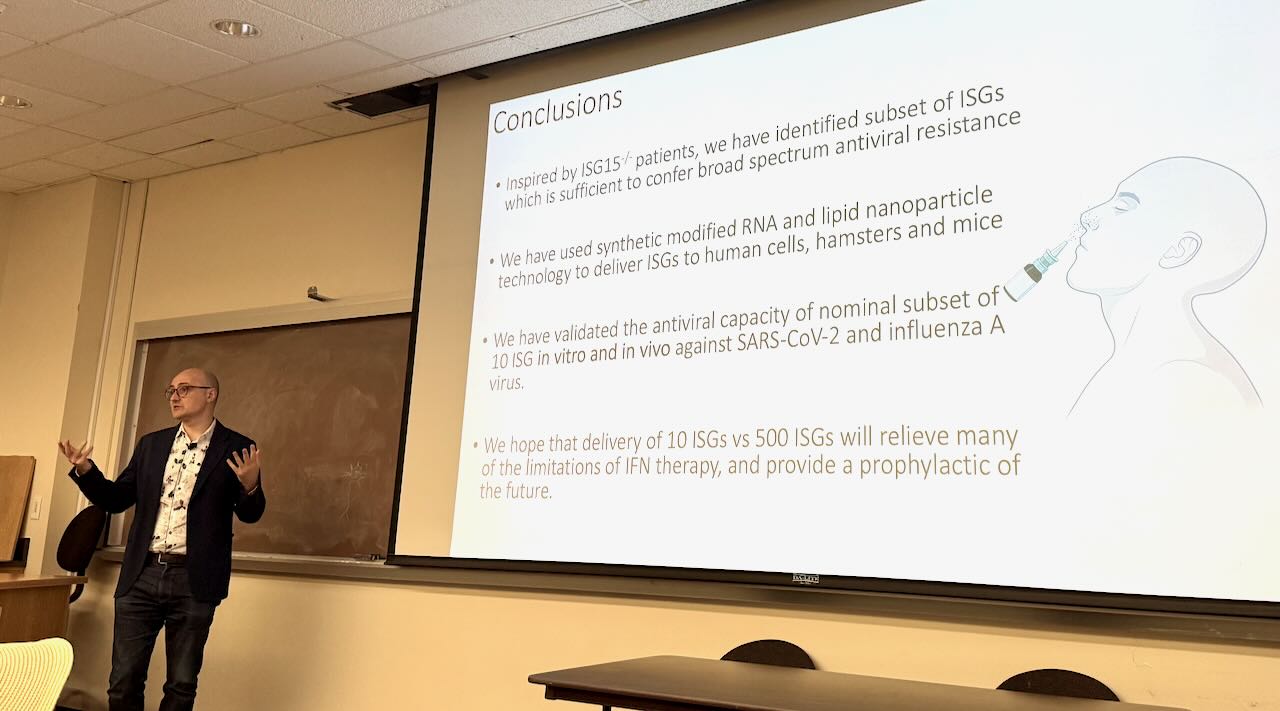
Bogunovic recently presented these findings in a talk at the University of New Mexico. He has shown that ISGs have potential as broad spectrum anti-virals, but only when given in combination. From the abstract in Science Translational Medicine: “A lipid nanoparticle-encapsulated messenger RNA (mRNA) formulation of this 10-ISG collection reduced influenza A virus plaque size in samples collected from infected mice when given prophylactically. Moreover, when used collectively and delivered prophylactically, the 10-ISG collection was able to protect hamsters against a lethal SARS-CoV-2 challenge, in contrast with the lack of efficacy when mRNAs were delivered individually. These findings suggest that these 10 ISGs have potential as a broad-spectrum antiviral prophylactic.”
Read the entire paper here: Akalu et al, An mRNA-based broad-spectrum antiviral inspired by ISG15 deficiency protects against viral infections in vitro and in vivo.
For additional context, read my previous piece on interferon here: Fighting over interferon.
Categories: Uncategorized

Joe Alcock
Emergency Physician, Educator, Researcher, interested in the microbiome, evolution, and medicine
 EvolutionMedicine
Leave a comment