Should we give aspirin to patients with sepsis and septic shock? After all, sepsis is believed to be a syndrome of dysregulated inflammation and coagulation leading to organ failure and death. Because of aspirin’s anti-inflammatory and anti-platelet properties, it should be helpful in sepsis, right! Right?Turns out that proposition is wrong:
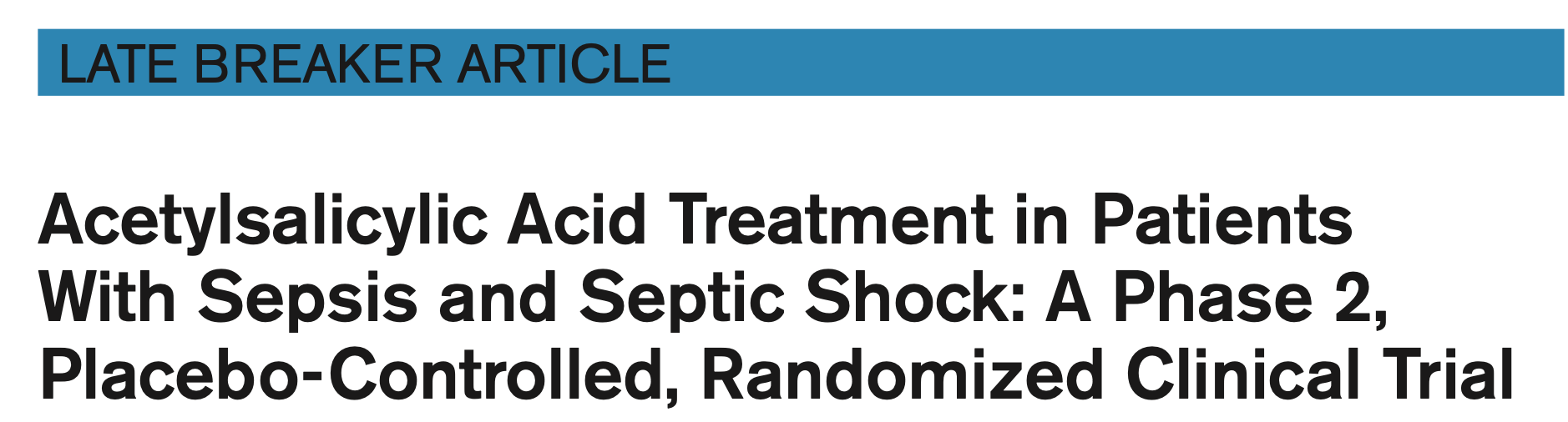

A trial by Tiago Almeida and colleagues randomized sepsis patients and organ failure to 200mg aspirin versus placebo. They had intended to enroll over 200 patients but stopped after enrolling 82 in the aspirin group and 84 in the placebo group. Why did they halt the trial? More adverse events – more bleeding specifically – in the aspirin group. Part of me wishes they had not stopped the trial and continued to their planned enrollment target. I understand the ethical concerns for safety and the need for interim analyses. But the consequence of stopping trials is that we are left with some degree of uncertainty. There are many studies that fall into this category. Here is one: Induced hypothermia in patients with septic shock and respiratory failure. The FEAST trial that we discussed recently was stopped early for futility. The Agus et al trial of tight glucose control in children was also stopped early for futility. The latter two trials trended towards increased mortality in the treatment groups. It makes sense to stop trials when the intervention seems to harm or kill children (and also adults). The problem is that many of these treatments, like aspirin, continue to be used in the real world. When we stop trials, often before reaching significance, and only when the intervention appears likely to be futile or harmful, it creates bias. This means that metaanalyses will tend to give a false signal of benefit, or false signal of minimal harm. Those are major problems.
Back to this trial. Aspirin is no better than Xigris in sepsis. In my view, sepsis interventions fail, not because of methodologic problems or other issues, but because natural selection shaped underlying immune and coagulation pathways. We have assumed these are dysregulated, but overwhelming evidence supports the opposite. As I told my students recently, sepsis is the gift that keeps on giving. Trials aimed at reversing “dysregulation” in sepsis, like this one by Almeida et al., will keep being published every year with results showing no benefit, or worse. These results have lessons for medicine and for evolution. One lesson is that evolved traits are often resistant to medical improvement, as in sepsis.
Copyright © Joe Alcock MD
Categories: Uncategorized

Joe Alcock
Emergency Physician, Educator, Researcher, interested in the microbiome, evolution, and medicine
 EvolutionMedicine
Leave a comment