Why does the immune system over-react and sometimes kill us? This is a conundrum that has attracted much attention, at least from evolutionary biologists. One explanation is the smoke detector principle. It is often better to over-react than to under-react. Here is a summary that I wrote in the evolution and medicine review: “Randolph Nesse coined the term smoke detector principle to explain why some people display an exaggerated response to threats, perceived and real, resulting in anxiety disorders and panic. He writes “False alarms are to be expected” because of uncertainty about the nature of a threat. That alarming noise behind you that triggers an involuntary intake of breath and a racing heart might simply be a harmless falling branch, or a charging grizzly bear. The overreaction to the falling branch evolved because hair-trigger reactions protect us from the far greater cost of being eaten alive.” This idea – which applies to panic and anxiety – is summarized in the carton below:
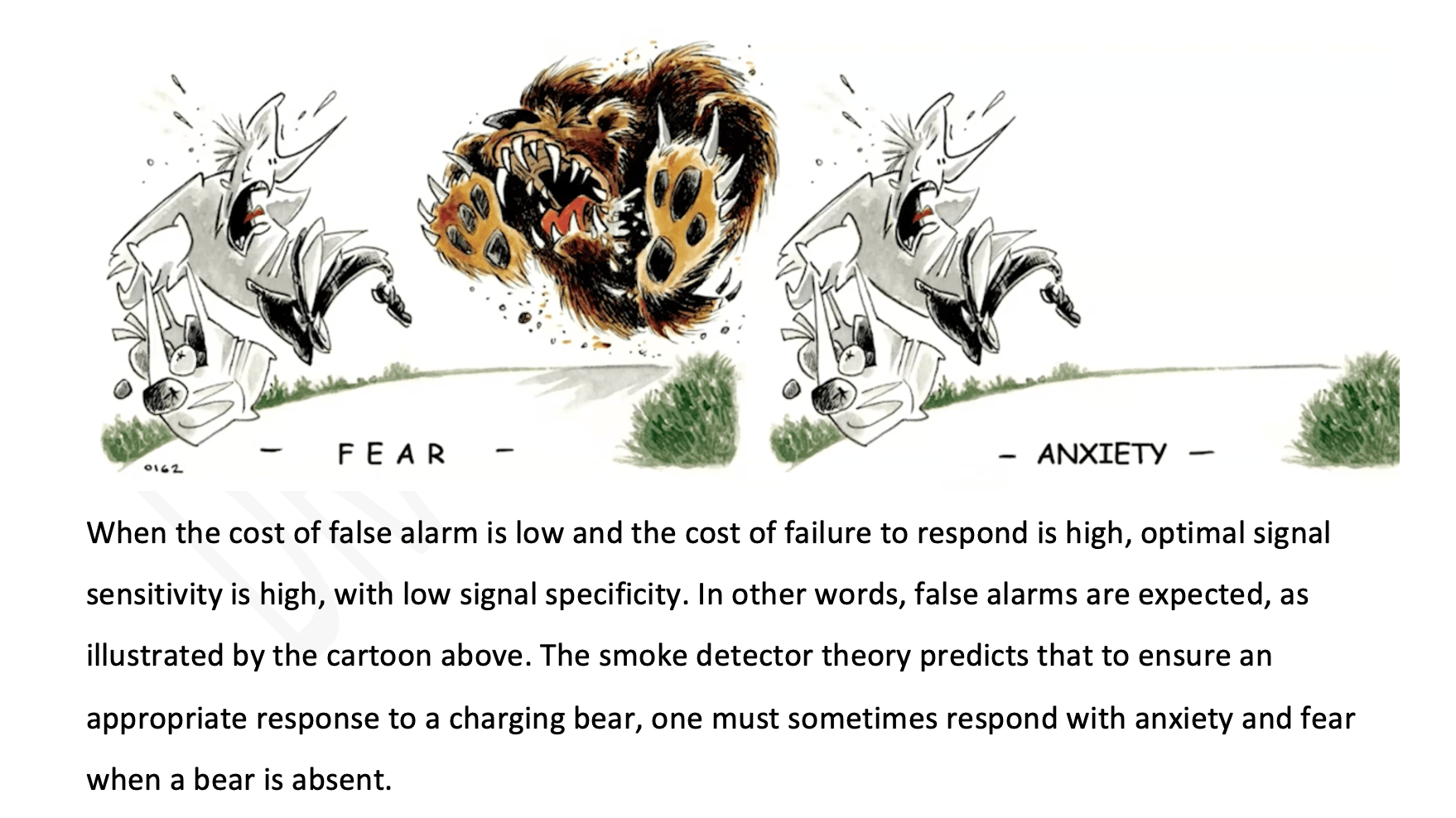
The smoke detector principle also explains why the immune system might tend to over-react. Delayed or insufficient reactions to harmful pathogens can be every bit as lethal as a charging bear. The smoke detector principle is important, but it is not the last word on this topic. Another reason why the immune system might overreact is because of infection by multiple organisms that require different – sometimes opposite – immune strategies. For example, a response that is optimal for an anti-viral response might increase susceptibility to a bacterial infection.
Alix Masters and I wrote about this idea in Evolution, Medicine, and Public Health: “The host may face a tradeoff during COVID-19 infection when they are infected at the same time by multiple other pathogens. Coinfection also tends to select for higher virulence in parasites generally and might be expected to worsen the severity of COVID-19. Chronic infections and multiple infections in COVID-19 are commonly reported. Many people are chronically infected with herpesviruses and other pathogens that are potent inhibitors of antiviral immunity, including the IFN responses that are a key defense against SARS-CoV-2. Consequently, some viral coinfections might worsen COVID-19 outcomes. Similarly, coinfection with bacterial or fungal pathogens may trigger maladaptive immune responses in COVID-19, in part because of tradeoffs between defenses against viral and bacterial infections.”
Perhaps the most salient reason for immune excess is that pathogens evolve ways to subvert our immunity, decreasing anti-infection benefits while raising the cost to the host. Infection by specialist pathogens that interfere with host immunity are more likely to cause catastrophic reactions with costs that exceed benefits.
A recent paper makes this point, suggesting that lethal sepsis in children is more likely to happen when young patients are infected by the Epstein Barr virus. EBV is a master manipulator, having evolved ways to evade the immune system and establish a persistent infection. EBV has been show to be a risk factor in auto-immunity – EBV seropositivity is highly linked with multiple sclerosis. Destructive self immunity results in debilitating neuro-degeneration in MS. It also may be responsible for sepsis deaths in EBV positive patients in the recent paper by Sriram et al in JAMA Open.
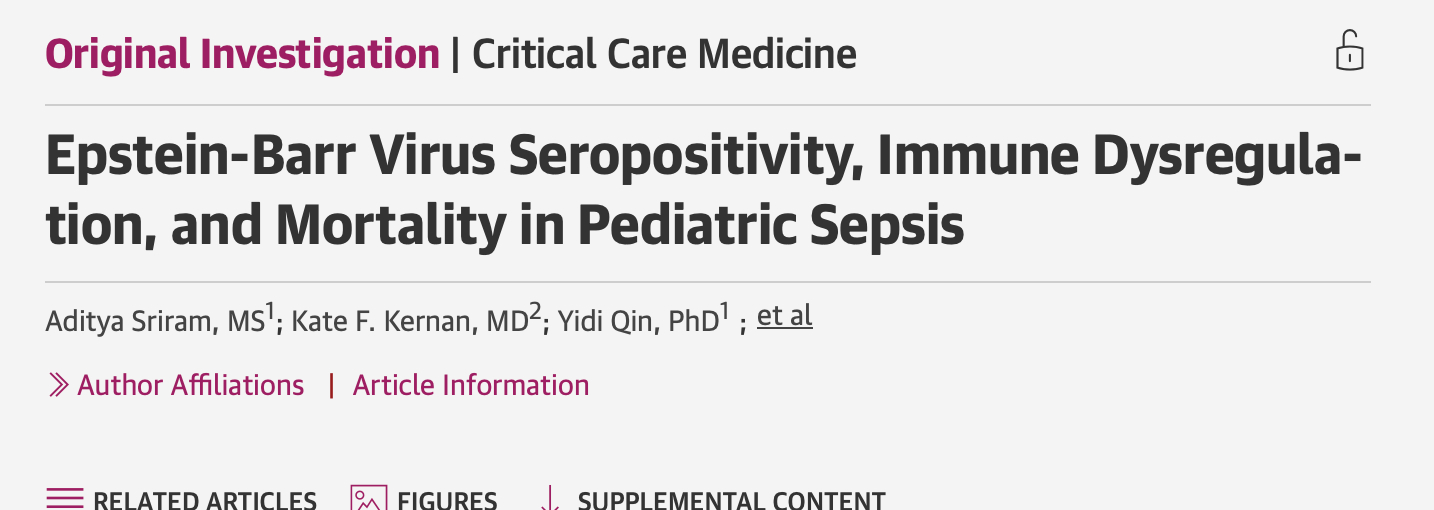
From the paper: “After adjustment for these admission confounders, EBV seropositivity remained associated with increased mortality in all 320 children (adjusted odds ratio [OR], 6.1; 95% CI, 2.1-17.9; P = .001) ” Lethal sepsis in EBV positive patients was linked to hyperferritinemia. The authors write: “These associations are consistent with the hypothesis that latent EBV infection contributes not only to chronic disorders of immune dysregulation but also possibly to acute disorders of immune dysregulation, such as sepsis.”
The results are also consistent with the hypothesis that immune overreactions should be rare and need special explanations when they happen. As Masters and I argued in EMPH: “Cytokine storms, when and if they occur, need more than a mechanistic explanation; they need a special case exemption, and an evolutionary rationale.”
One such special case is a chronic infection by a pathogen that is really good at undermining the human immune response. I predict we will find other immune diseases in which EBV has a un-appreciated role. Before accepting that the host response is dysregulated, we need to look for additional risks, e.g. EBV. This view suggests that vaccines and other strategies against immune-subverting pathogens such as EBV will protect us from some immune-related death and disability.
Categories: Uncategorized

Joe Alcock
Emergency Physician, Educator, Researcher, interested in the microbiome, evolution, and medicine
 EvolutionMedicine
Leave a comment